Showing posts with label Corporate Team Building. Show all posts

Wednesday, December 1, 2010

How to Lead Awesome Team-Building Programs. E-Book

Did you ever wonder “How does one lead AWESOME team-building programs? The ones that ensure that content and learning take place. A teambuilding program that is fun, and teams leave better than when they arrived?”

Now you can find out.


In this 55 page E-book you will find applicable strategies, team-building activities, facilitation, de-briefing, and processing activities + theory that you can use immediately.

Content sections:

Theory Based Facilitation and Experiential Learning;

  • Providing a theoretical foundation to leading team-building programs. In this section you will learn – Ideas and practical applications of team-building, instructional design, and hands-on learning.

Question based facilitation and Experiential Learning

  • Over 10 different techniques for using questions for learning, and applying content to the team-building and experiential programs.
  • Many, many, many questions that will engage and allow the content learning and team-building to stick
  • Hand-outs that you can use immediately in your programs and meetings
  • Interactive learning activities that use questions to enhance your presentation, and team-development

Activity Based Facilitation and Experiential Learning

  • Learning by doing…making de-briefing and processing fun! If you are new or you are a seasoned veteran the activity based facilitation of team-building programs will make your programs better and you be the BEST facilitator possible.


Questions? Contact Mike…

to purchase click here

Friday, February 26, 2010

Corporate Team Building for Collaboration

corporate team building buffalo-rochester-syracuse ny

Above is an image from a Corporate Team Building Program

Following a content training on inter-department collaborative project planning with a step-by-step action plans for enhanced collaboration on team projects including the following steps:

  • Purpose
  • Vision
  • Inventory
  • Goals
  • Action Steps
  • Resources
  • Communication
  • Execution
  • Followup

The teams were challenged to get into mixed department teams and place their collaboration project plans into action.

Gutterball
Gutterball offers insights into the needs that different team members have for information and detail, how people like to work in either a structured or unstructured approach to problem solving and change, and how quickly and slowly people are willing to move ahead with a plan based on how much they know and understand about the solution.

Michael Cardus 

Wednesday, February 17, 2010

Decision Making Methods for Team Effectiveness

Decision Making Methods for Teams

While a decision within organizations often relies upon facts and data, teams must agree upon a method for making decisions based upon the data. Ensuring that the decisions made are done with a process and purpose that the team can utilize to make the best possible decision with the given facts and data.

There are many different decision making styles, two methods must be chosen to serve as guideposts for decisions made. The primary method must be agreed to by the team and a back up method must also be chosen. The methods can and will vary upon the people and stakeholders making the decision as well as the knowledge of the facts and data that the team possesses when making the decision.

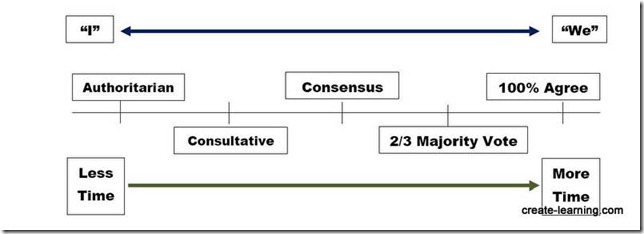
Below is a decision making spectrum as well as the advantages and disadvantages of each method.
Team Decision Making

Authoritarian
Authoritarian decision making is a decision that is placed within the hands of one person who chooses quickly and without regard for input from others. Typically this method is utilized when either there is a crisis and calls for an immediate decision or when the decision is mundane in nature.

Advantages and uses;
•    Quick decision made when the leader may possess more information than those being affected by the decision.
•    When the authority figure has the trust and “best interest” of those who are affected by the decision.
•    The speed of the decision being made, decision can be made quickly
•    Decision is not watered down with compromises

Disadvantages;
•    Decision lacks involvement of those who are affected
•    Those affected have decreased chance of “buy in” to decision made
•    Chance of incorrect decision based upon poor judgment and incorrect facts

Consultative
Consultative decision making is the type where decision making power is in the hands of one person and the person actively solicits the ideas, suggestions, and opinions of others.

Advantages;
•    People who are affected by the decision are sought out for their input, allowing for greater buy-in to the ultimate decision made.
•    By seeking input from varied sources a better and more knowledgeable decision can be made

Disadvantages;
•    It takes longer
•    Buy-in of the ultimate decision with the consultative method only occurs if your input is finally decided on by the decision maker
•    If the decision maker already has a pre-determined choice in mind and is only “going through the motions” showing a false consultative style, this method backfires rapidly.

Consensus
Many misconceptions haunt consensus; it is not a tool in total agreement among the team, nor is it a type of voting.
Consensus is a decision making method where all parties involved have input of the decision to be made and whatever agreement is reached (i.e., compromise) will not be sabotaged by the team.

Advantages;
•    Full participation by the entire team; involves total involvement of the team
•    Total participation increases buy-in to the decision made
•    With input from the total team the ultimate decision is not made until there is agreement therefore showing total buy-in from all team members.

Disadvantages;
•    Necessitating buy-in from the total team take a longer time frame
•    Final decision made are often “watered down”

Majority Vote
Consensus will often prove to not be a viable option. Therefore a backup is needed; usually majority vote is a suitable back up. Majority voting is rarely ever used as the primary decision making method.

Advantages;
•    Decision can made with a less watered down solution
•    Speed of decision can be increased, following a lengthy consensus process

Disadvantages;
•    Voting creates winners and losers
•    Those who lose may be more inclined to sabotage the decision, creating the possibility that whatever decision reached will not be properly implemented.

100% Agreement
It is a rarity when a diverse team is asked to make a decision that 100% agreement is ever truly reached.
Thus it is strongly recommended that this method should never be used, not even as a back-up.

Michael Cardus

Tuesday, February 16, 2010

Team Building Consultant | Trainer | Facilitator; 3 Overlapping Roles for Success

3 roles of team building buffalo Rochester Syracuse NY
Team Building consultants generally use three overlapping, but distinct roles. Each role  mentioned below keeps the learning and Team training meaningful, self-reflective, team-reflective, and fun!
The overlapping of roles are best summarized in the explanation below:

• Consultant. In this role, he establishes and maintains contact with the client, jointly assesses the client's situation, elicits information, designs programs, serves as confidant and adviser to the primary client contact.

• Trainer. In this role, he sets the tone of the training, then communicates, educates and improvises as he orchestrates and delivers the content through a sequence of activities and facilitated group discussion

• Facilitator. In this role, he leads the debriefings [processing], engaging and challenging participants to dig for deeper meaning, mediating disagreements and pushing for ever-greater clarity and understanding.

Each of these roles is inter-dependent upon each other. For example if the training lacks the full "buy-in" or approval of the primary client contact, (usually Executive Level, Team Leader, or a Supervisor in some capacity), the program will fail to reach a higher level of success and fail to have a long term effect on the team and the participants within the team.

It is imperative that a discussion takes place between the Team Building Consultant and the client contact. All parties need to reach an agreement on how the program will progress, what objectives and goals are going to be reached as well as how to follow up the Team training program.

What if the client contact is unclear about what objectives and goals to be reached? That is where the Team Building Consultant should meet, process and enable the client contact to better see and understand what it is that really needs to be addressed in the training session. If the Team Building Consultant can not facilitate a discussion to lead to clarity on goals and objectives both parties, the consultant and the client, should agree to go elsewhere.

Additionally during the training new evidence of inter-behavioral barriers may present themselves and the program takes an unexpected turn. This is when the true test of a trainer's ability becomes evident.
  • Does the facilitator choose to stay the course and work on the pre-defined objectives?
  • Does the trainer choose to go in a different direction and follow what has just arisen?
  • Does the trainer have the skills, knowledge and abilities to in a synergistic fashion meld both together?
Experienced Team Building Consultants have been in all three situations and the answer really is "YES". It all depends on the situation at hand.

That is why when choosing a team building consultant and team building company an organization must research and feel comfortable with the qualifications of the facilitator.
Some questions to ask team building companies are as simple as;
  • who are your facilitators?
  • Can you tell me an example of a program you have lead that is like our situation?
  • Can you supply me with a list of sample questions you ask during the debrief [processing]?
  • Give us a specific example of a program you have created that was a success? A failure?
  • Can you provide my organization with a written proposal or agenda of what will be accomplished during our team training?

An effective team building consultant has the ability to move seamlessly through the consultant; trainer; and facilitator role. This comes from experience and Team Building consultants who are well educated and trained, in several fields. Choose the right consultant and who puts your team and success first.
*
*
Michael Cardus

photo by Kecko

Saturday, February 13, 2010

Leadership Levels have Different Indicators of Success


leadership indicator

An amazing graphic representation of the indicators of successful leadership necessities.

Illustrating that as people progress through their leadership careers the skills they need do not remain static.

At the executive level, for example, directive leadership actually played a negative role. Empowering leadership is what is required at this level. Although a top-down, command and- control approach proved to be counterproductive, neither supportiveness nor abrasiveness differentiated the effectiveness of executives at this level. That is, interpersonal skills are not as important at the top as they are at other managerial levels. Interestingly, work-life balance proved to correlate negatively with effectiveness, confirming what most executives already assume: anything less than full devotion to the job may compromise results….to read original article from Korn / Ferry Briefings on Talent & Leadership.

One area that is common to all is a need for the skill in “Learning Agility”. This indicates that for effective leadership (as well in life) the ability to learn and apply the new learning is across the board is necessary.

Does your leadership culture encourage learning agility?

What are your thoughts about the negative indicator of the work / life balance of executive leaders?

Graph from Korn / Ferry Briefings on Talent & Leadership.

Michael Cardus

Tuesday, February 9, 2010

Leadership Development Process Program

Leadership Development Process

“People join organizations;
People leave bad bosses.”

Create-Learning’s Leadership Development Process is developed, customized, and focused on you and your leaders to ensure the greatest return on investment.

Available to Individuals and Organizations contact Mike to flourish as a leader

Within the process examples and case studies from your organization are used to train, create, facilitate and increase leadership.

The mix of learning simulations, personality profiles, 360° feedback processes, organizational leadership examples, Leadership Coaching and the knowledge shared by the participants make this leadership program able to supply people with immediate skills, practices and techniques that can be utilized within their teams, organizations, home lives and communities.

Within the Leadership Process people learn the emotional, organizational, and professional skills to be the leader that people look to as the reason to remain with your organization.

Equaling trusted leaders, increased effectiveness of work teams, increased ability to leverage available time and team members’ time, increased retention of team members, utilization and maximization of resources and staffing.

Outcomes to leaders from the Leadership Process;
•    Ability to properly implement process and people leadership
•    Tools for the measurement of team effectiveness
•    When, How to, and why to use tools for the measurement of team effectiveness
•    Effective development and placement of people on High Functioning Teams
•    How to establish and guide team processes
•    Effective skills, and techniques to coach team members
•    How to coach and re-focus underperforming team members
•    Leaders are able to reflect upon their own behaviors and able to adjust accordingly based upon what team and whom they are leading.

How does it work?
•   
The process lasts for 6 months

•    Leadership Process meetings twice a month

•    Leadership Coaching Sessions individually with each person once a month

•    Monthly field assignments that are real organizational applications of Leadership

•    Creation and utilization of a private invite only website for the Leadership Process Participants to post their field assignment results, share information and best practices, comment on each other’s progress, and to serve as an organizational best practice leadership tool.

•    Each Leadership Process Participant plans, implements, refines, and presents a Leadership Project.

Once you are ready to Flourish as a Leader and / or develop an organizational culture of Flourishing Leaders contact Mike and take action to reach your potential as a Leader!

Saturday, February 6, 2010

Mike has won the 6 Sigma Commenter Award for the 2nd Year in a ROW!

On Wed., Feb. 3, iSixSigma Live! presented its annual awards breakfast honoring the companies and individuals who have successfully applied strong practices and achieved breakthrough results through continuous improvement. The morning began with the iSixSigma MVP Awards, recognizing the voluntary contributions to the Six Sigma community through the iSixSigma Discussion Forum, Blogosphere and Twitter. The winners for 2009 were:

  • Most Prolific Poster on the iSixSigma Discussion Forum: Stan

  • Most Helpful Poster on the iSixSigma Discussion Forum: Robert Butler

  • Best Blogger on the iSixSigma Blogosphere: Sue Kozlowski (for the second year in a row!)

  • Best Commenter on the iSixSigma Blogosphere: Michael Cardus


For the 2nd year in a row – I have won the 6 Sigma Blog commenter of the year – It is great just to be nominated, and to win 2 years in a row is a point of pride for me!

Especially as I am presenting at the Buffalo NY, ASQ (American Standard for Quality) to present a workshop at their conference in October of 2010 on Team Building (development) for 6 Sigma Projects.

-Michael Cardus is the founder of Create-Learning-Team Building, an experiential based training and development consulting organization. Mike specializes in team development and leadership development consulting and training, creating team-building programs that retain talented staff members, increase production and effectiveness of your team. He lives in Buffalo, NY, and travels to you to serve your team-building and leadership training needs, wherever and whenever fits your schedule.

Monday, February 1, 2010

Hard Skills Depend Upon Soft Skills

Team Building & Leadership Buffalo NY

I was consulting / facilitating with a large utility company in New York, we were focusing on adapting Kouzes & Posner’s The Leadership Challenge to complement their existing leadership development program.

The above image is of an activity I call “Hard Edge and Soft Middles”, I led this initiative as a table top simulation to connect the content piece of how our communication, emotional intelligence, delegation, empathy and other skills are the foundations of process effectiveness. The leaders (until the point of our de-brief) were having a challenging time transferring the idea of the “Leadership Challenge” and facilitative leadership style vs. a command and control style that was being used too heavily within the teams.

The discussion following was in-line with the need to determine relevancy of the companies work, great examples and techniques to Enable others to act and how to Encourage the Heart of the leaders and those on the teams.

How do you deliver content that enables people to transfer a “soft skill” (people skill) into a “hard skill” (process skill)?

What steps can be used to connect the pieces?


Michael Cardus

Saturday, January 30, 2010

Leadership – Vision + Time Management


Brian co-facilitating the time management section of a Leadership Development Program for a group in Buffalo NY.

-Michael Cardus is the founder of Create-Learning-Team Building, an experiential based training and development consulting organization. Mike specializes in team development and leadership development consulting and training, creating team-building programs that retain talented staff members, increase production and effectiveness of your team. He lives in Buffalo, NY, and travels to you to serve your team-building and leadership training needs, wherever and whenever fits your schedule.

Tuesday, January 26, 2010

Team Membership Program

Team Membership Program

Utilizing the Team Dimensions Profile

The Team membership program will help the participants understand the way they prefer to work.

This is accomplished by the participants gaining insight to work from their strengths by identifying their most natural team role, while giving them appreciation for the contribution of others.

The profile identifies the following five team roles; Creators, Advancers, Refiners, Executors, Flexors. After the team defines their roles examination of a profile map for assigning roles, completing tasks and handing off tasks to other team members through the “Z Process” is discovered. In this relay process tasks are passed from Creators to advancers, from advancers to refiners, and from refiners to executors – flexors fill in the gaps to keep the process moving forward. 

The team will have a common language and understanding of a process to

  • innovate
  • problem-solve
  • reduce cycle time (Process Improvement)
  • understanding and capitalizing on individual approaches to group processes to develop high performance results

The Team Dimensions Profile works by;

• Matching individual strength with team roles
• Building team unity
• Fostering innovation
• Shortening Project Cycle Time
• Reducing Conflict

Complementing the Team Dimension Profile Create-Learning will lead content based experiential-facilitated discussions and simulations to connect the relevance of team membership and leadership reflection to the team and workplace.

The participants will have an understanding of;

  • Successful resolution of team conflict
  • How to delegate and ensure commitment of responsibilities to team members
  • How to determine team member strengths and weaknesses


-Michael Cardus is the founder of Create-Learning-Team Building, an experiential based training and development consulting organization. Mike specializes in team development and leadership development consulting and training, creating team-building programs that retain talented staff members, increase production and effectiveness of your team. He lives in Buffalo, NY, and travels to you to serve your team-building and leadership training needs, wherever and whenever fits your schedule.

Saturday, January 23, 2010

Team Building Pitfalls

My friend Anne Thornley-Brown of Corporate Team-Building and I have been speaking about team building and how to lead successful team development programs for some time now.

In her latest blog post Top 10 Team Building Pitfalls she lists areas of focus for any organization (corporate, community, youth, etc…) ought to be thoughtful of…you can read each of these in greater detail on Anne’s Blog;

  1. Failing to allocate sufficient time for planning
  2. Scheduling your session to end on a day before your weekend
  3. Choosing your venue before you have determined the content of your team building session
  4. Failing to stay where you intend to play
  5. Not factoring in the impact of weather and allowing extra time to get to your venue.
  6. Failing to allocate more time for your session if your group is highly analytical
  7. Not leaving wiggle time in your agenda
  8. Not giving people enough down time
  9. Failing to have an emergency plan
  10. Not scheduling checkpoints with your facilitator and involving your facilitator in problem solving

I would like to add one extra step – Constantly challenging your facilitator (team building provider) with the question of “How does this apply back to our work?”

A team building consultant (and not recreation specialist) will be able to facilitate, process, and empower your team to connect the dots and determine the relevance of what is being done to how it will improve their team.  You are paying for a program that is meant to increase team work and in turn make your organization more productive and successful. This requires purposeful discussions and initiatives that explore behaviors, habits, actions and processes that are embedded in the team. When the team building facilitator is working with the team every step, every process, every initiative, should have content and purpose that is focused on your team and goals.

A drum circle is great although beating a drum next to a co-worker is not going to create a stronger team unless there is a discussion about; How does this apply back to our work? The facilitator must be able to answer this at every part of the program.

Constantly challenge the facilitator with the question “How does this apply back to our work?” 

-Michael Cardus is the founder of Create-Learning-Team Building, an experiential based training and development consulting organization. Mike specializes in team development and leadership development consulting and training, creating team-building programs that retain talented staff members, increase production and effectiveness of your team. He lives in Buffalo, NY, and travels to you to serve your team-building and leadership training needs, wherever and whenever fits your schedule.

Monday, January 18, 2010

Team Leadership Program – Case Study


Team Leadership Program

Team Leadership Program Situation Summary:Team Leadership Development Buffalo NY

Create-Learning was contracted to develop a Leadership and Social Development programs for 15 people at the director and manager level of a retail operation.

The average age of the participants was 36, the average experience in the retail field is 10 years.

The leaders would benefit from experiential programming to enhance teamwork and effective membership within a team.

With a focal point on leadership based context of social & emotional intelligence, for internal teams (staff members, direct reports, supervisors) as well as external customers (customers, vendors, suppliers, etc…)

The Retail Directors & Managers are all driven, focused and intelligent.

When you have driven individuals the focus on the team and purpose of the project can be lost.

Once the purpose of the project is lost the learning and overall productivity of the individuals decrease.

The directors and managers are in need of skills, tools, and techniques to be high functioning team leaders as well as the emotional intelligences to effectively lead as a team member and function as a member of the leadership team.

High Functioning defined as - all individuals are committed in words and actions to the teams; Purpose, Decision Making, Expectations, Resources and Process.

Objectives for Team Leadership Program:

· Increasing leadership skills

· Directors & Managers to have a common language of Team-Membership and leadership

· Completion and report of a Leadership Project

· Develop skill sets in

  • Effective behaviors of Team-Membership
  • How to develop teams and team goals
  • Ability to properly implement process and people leadership
  • Tools for the measurement of team effectiveness
  • When, How to, and why to use tools for the measurement of team effectiveness
  • Effective development and placement of people on High Functioning Teams
  • For leaders to reflect upon their own behaviors and learn to adjust accordingly depending on the team that they are asked to lead and be a part of.

Value of Team Leadership Program:

· Trusted leaders

· Increased effectiveness of work teams

· Increased ability to leverage available time and team members’ time

· Increased retention of team members

· Utilization and maximization of resources and staffing.

Team Leadership Program Methodology:

Create-Learning facilitated 40 hours of programming (Utilized over a 6-month period)

Within these programs the leaders were engaged in experiential, content based programming.

The content covered;

  • Team-Membership - Individual, Social and Team accountabilities of team members
  • Leadership - Based upon the 6 Primal Leadership styles. Participants gained tools in what the styles are, when each style is most effective, how to spot other peoples style and how to fill the gaps in the styles.
  • Transference - guided hands-on application and relevance of Team and Leadership theory. Empowering the leaders to find applicable uses for the Team-Membership and Leadership styles.

Create-Learning used experiential learning simulations with small group content delivery to ensure lasting learning from the programs.

Additionally each of the 15 leaders had to propose, design, develop and institute a leadership project within their existing team. The projects guidelines were as follows;

  • Must utilize existing resources (no extra money and / or staff, etc…)
  • Must include staff (delegation, goal setting, decision making, problem solving, coaching)
  • Must be in-line with organizations mission, values, and culture
  • Must be measureable

Outcomes:

  • The leadership team was able to reduce overtime, increase the average sale to the customer and increase the average sales commission of team members. This was accomplished by the leadership team examining its existing processes and re-organizing the process to return maximum results.
  • Employee satisfaction (results gathered from employee surveys) increased, showing that leadership was better at developing strengths and creating challenging yet achievable goals for teams and team members.
  • The leaders were able to create a system for employees to fill in shifts at other locations. This system enabled the organization to maximize employee and leadership time as well as lessen burn out and stress amongst team members.


All Leadership programs are customized and developed for your unique organization.

Contact us to discuss and create a customized Leadership Program for your team!


-Michael Cardus is the founder of Create-Learning-Team Building, an experiential based training and development consulting organization. Mike specializes in team development and leadership development consulting and training, creating team-building programs that retain talented staff members, increase production and effectiveness of your team. He lives in Buffalo, NY, and travels to you to serve your team-building and leadership training needs, wherever and whenever fits your schedule.

Tuesday, January 5, 2010

TeamBuilding & Leadership Images


Favorite images of 2009!
The Corporate, College, Community, Classroom, 
High Ropes, Low Ropes
Team Building and Leadership Development photos 
that bring a smile to my face.


-Michael Cardus of Create-Learning-Team Building
Posted by Picasa

Tuesday, December 29, 2009

Increase Purpose, Decision Making, Expectations, Resources and Process

Below is a program outline for a 4 day training that I recently led.

In attendance were 25 Front Line Employees and 10 of the companies Leadership Team.

Over the 4 days the specific outcomes were;
- A focus, goals set, accountability recognized and action plans put into place to increase quality and productivity.
+ Leading to a decrease in wasted materials / resources and lost opportunity due to communication breakdowns and in-fighting.

- Increase in communication between shifts and between co-workers about work-related issues.
+ Leading to a decrease in over-lapping and repeated processes, as well as decreases in the amount of time needed for set up between and before shifts.

- Increase in team unity by getting the team to value the other team members and share information that will aid the team in success.
+ Leading to a decrease in lateness, absenteeism, and noticed decrease "us" vs. "them" mentality of Leadership and Front Line Workers.

Team-Building Program Outline:

Pre-Sessions – Introduce Mike Cardus to the team.
- All participants will take the DiSC assessment: DiSC Workshops. Overview of personal and team personality and behaviors.

DAY 1:
Open Program –
Who are we and why are we here (team and facilitators)
- Cover organizational; team; participant; facilitator Goals
- Team behaviors for the remaining programs – long term behaviors within workplace
- Intra-Department Team Listening & Speaking
- Inter-Department Team Listening & Speaking

DAY 2:
Revisit Goals and Behaviors as needed
- Tuckman’s stages of Group Development Forming-Storming-Norming-Performing-Adjourning
- Listening & Speaking for understanding of groups stage & implications on team planning
- Non-Verbal Communication skills & pitfalls on communication
- Stress & the effects on team performance and communication-skills to recognize stress within self & team members. Skills to listen & speak effectively within stressful interactions.

DAY 3:
Revisit goals & behaviors
How are we doing? What are you (the team) doing different?
- Sharing information for group success – breaking the “not my job philosophy”
- Creating group and team accountability – from the team leaders to the team members
- Conflict Styles – Competing; Collaborating; Compromising; Avoiding; Accommodating
- Using Conflict & Accountability to lower cycle time & increase throughput

DAY 4:
Revisit behaviors, communication (listening and speaking), Conflict-Accountability
- “Silo” development – how they can help and hinder individuals who make the teams.
- Shift to Team Goals and accomplishments – shifts working together for overarching organizational goals
- Overview of Team Performance Model
- Team & Personal action plans for the future
- PARTY! Team presentations celebration.
- Hand out certificates and award ceremony


FOLLOW UP: ~15 days after last session – done during shift times 60-90 minutes per shift
Revisit workshops and goals with teams
- What has changed within the teams (between shifts & within shifts)
- Reinforce information & Knowledge sharing
- Reinforce Team & Shift Accountability
- What do you (teams) feel you need more of from us (facilitators) from The Company for continued success?


All team building programs are customized and developed for your unique organization.
Contact us to discuss and create a customized indoor or outdoor TeamBuilding Program for your company & Team!


-Michael Cardus is the founder of Create-Learning-Team Building, an experiential based training and development consulting organization, as well as a blogger for TeamBuilding NY. Mike specializes in team development and leadership development consulting and training, creating team-building programs that retain talented staff members, increase production and effectiveness of your team. He lives in Buffalo, NY, and travels to you to serve your team-building and leadership training needs, wherever and whenever fits your schedule.

Friday, November 27, 2009

WorkPlace Department Perception - TeamBuilding Activity

Organizational Perception Charts

Materials:
Multi-Colored markers
3 flip charts per department

Objective:
For team members to explore their perceptions of the other departments and for departments to explore their perceptions of other departments.

Additionally for departments to explain their role to people who are not in their department.

Preparation:
Prepare three flip chart pages per/dept and write the name of the department on the top of the flip chart paper.

Below the department title split each page into 3 sections and label these sections;
Feel free to alter any and all of these.

• High Points
• Low Points
• Goals

Tape these flip chart papers to the walls and allow plenty of room between papers for people to write and move around.

Instructions and Facilitator Script:
In a moment you are going to work as individuals on this following task.
You will see that we have affixed flip charts with each of the departments here today.
I am going to ask all of you to spend about 15 minutes walking to each department and listing what you feel are that departments;

• High Points
• Low Points
• Goals.

Please write on every department except the one you work for.
Please be honest and share your knowledge of the other departments.

Following the 15 minutes of writing on the flip charts please sit with your department, take down the flip chart papers about your department and spend about 10 minutes as a department discussing what others have written and perceive about your department.

Take time as a department and reflect and question each other as to why other people would perceive and not perceive these things about your team.

After the 10 minute discussion each department will have time to explore, clarify, define, and answer to what the perception of their department is.

Facilitator Notes:
With this be careful and ask the participants to keep an open mind.
If you feel that this will turn into a negative complaint-fest then DON’T DO IT.

Department and Teams can be insulted and challenged when faced with how others perceive what they do.
Work is a very personal thing to people, respect that and encourage the people to also respect that.
Do not rush this activity, allow it to move slow and take time.


Potential Processing Questions:
• What were some key items that you noticed during this time?
• What areas of our work could our own teams be blind too?
• How can we increase the knowledge of what is happening inside the organization?
• What are some factors that cause departments to have incorrect perceptions?
• In what ways can this incorrect perception affect our organization?
• How can we change this?
• How can knowledge of other departments high points, low points, Goals, etc… enhance our work and increase customer satisfaction?
• What are we going to do with this knowledge?
• What actions can we take when in the office to change these perceptions?


-Michael Cardus is the founder of Create-Learning-Team Building, an experiential based training and development consulting organization, as well as a blogger for TeamBuilding NY. Mike specializes in team development and leadership development consulting and training, creating team-building programs that retain talented staff members, increase production and effectiveness of your team. He lives in Buffalo, NY, and travels to you to serve your team-building and leadership training needs, wherever and whenever fits your schedule.

Wednesday, October 7, 2009

TeamBuilding from College Sports to Business Professionals

University at Buffalo, NY - Womens' Softball Team
Here the team is focusing on accountability for your role on the team

A Business Group in Rochester, NY
Engaged in a closing activity that focuses on individual learning and how it can be applied to the team.


Buffalo, NY Teacher In-Service
Focusing on trust and effective communication to the teaching staff


Leadership Educators in Buffalo, NY
Engaged in a level 2 Rope Handcuffs activity.
Level 2 focuses on the group working together to accomplish a challenging task.


Team of Young Professionals
Once you are in a department communication and collaboration between and within departments is necessary for organizational success


-Michael Cardus is the founder of Create-Learning-Team Building, an experiential based training and development consulting organization, as well as a blogger for TeamBuilding NY. Mike specializes in team development and leadership development consulting and training, creating team-building programs that retain talented staff members, increase production and effectiveness of your team. He lives in Buffalo, NY, and travels to you to serve your team-building and leadership training needs, wherever and whenever fits your schedule.

Wednesday, September 30, 2009

Collaboration Team Building Proposal


Sample Team Building
Focus on Information Sharing Proposal


All team building programs are customized and developed for your unique organization. The below is only a sample proposal. Contact us to discuss and create a customized indoor or outdoor TeamBuilding Program for your team!


Team Building Information and Collaboration Program Overview;

With the changes taking place within the organization communication and collaboration is being lost with the team members leading to a loss of trust and customer satisfaction.

With an increase of inter and intra department collaboration and communication the team will continue to thrive and developed talented leaders and team members in turn increasing customer satisfaction, sales and revenue.

This Teambuilding program will serve as an opportunity for the team members to discuss their roles and facilitate a discussion to gain clarity on areas and steps to improve the One Team feeling and communication / collaboration amongst the new and existing departments.


Objectives

The objectives for this project include;
- Increase inter and intra department communication
- Allow for people to get to know and learn from each other in an enjoyable environment
- Develop an enhanced accountability of the people within all departments and locations to operate in the best interest of their customers, themselves, their team, and organization.
- Develop plans for increased team member collaboration on projects


Measures of Success

Our metrics will include;
· Program evaluations
· Interviews and conversations with Leadership Team Members, as to effects on the team and team members
· Additional evaluation assessments to determine the impact of the reaction, learning, behavior change, and end results of the program are available for longer term projects (6 month requirement of program implementation required)

Values

The value of the program;
· Increased morale within the team
· Team members will feel ownership of changes within the organization
· Strengthened and new friendships amongst team members
· Increased collaboration amongst people and departments on projects and decisions within the organization
· Empathy and understanding of the other people’s positions and job pressures.


Team Building Methodology and Options

All options include unlimited meetings, phone conversations, any and all discussions and meetings leading up to and after the program dates.

Option 1: Create-Learning will lead team development, collaboration and communication based initiatives
We will facilitate the team through initiatives and reflections on improving trust, communication and collaboration within the Team.
Completing the program with action lists and items that the people and the team can use to begin to implement the learning and ideas gained from the program.

In addition we will facilitate problem solving and brainstormings with a focus on what the people need to achieve success and how they can utilize their internal strengths and resources better.

A focus will be on the ability of the individuals within the team to openly discuss their perspectives on the issues. Allowing the team to have a greater understanding of all the individual perspectives they will be able to institute the best option for success.

Option2: Includes option 1 plus;
Create-Learning develop a customized assessment for the participants prior to our time together, using their inputs to deliver the most targeted areas for team development.

Option 3: Includes option 2 plus;
All participants who are taking part in the program will take a

DiSC assessment. - http://create-learning.com/DiSC.aspx
Or
Team Dimensions Profile -
http://create-learning.com/teamdimensionsprofile.aspx

The profile assessments will be used to enhance the program.


All team building programs are customized and developed for your unique organization. The above is only a sample proposal.

Contact us to discuss and create a customized indoor or outdoor TeamBuilding Program for your team!


-Michael Cardus is the founder of Create-Learning-Team Building, an experiential based training and development consulting organization, as well as a blogger for TeamBuilding NY. Mike specializes in team development and leadership development consulting and training, creating team-building programs that retain talented staff members, increase production and effectiveness of your team. He lives in Buffalo, NY, and travels to you to serve your team-building and leadership training needs, wherever and whenever fits your schedule.

Friday, September 18, 2009

Team Building for Creative Problem Solving & Information sharing


Infinite Loops

Materials:
Rope loops - one per person

Objective:
Small team and large group team building & communication and problem solving
For all partners to become separate, the activity is not complete until there is a full organizational success.

Preparation:
You are going to want to practice this one for mastery!
Each person is issued one section of rope.
Get a partner
Pass your hands through the loops of your rope section so that you and your partner are connected by your ropes.
Refer to the image above.

Instructions:
1. Your wrist loops must stay on your wrists throughout the entire activity.
2. The rope may not be cut (in any manner).
3. The knots may not be untied.
4. If partners get tangled up its allowable to take hands out of the wrist loops and start all over again.

Facilitator Script
“This next activity represents a challenge in problem solving plus the ability of our group to share best practices throughout the organization. The goal of the activity is to get free from your partner and to take part in sharing best practices throughout the organization.

Here is the way the activity works in a moment each of you will have your own infinite loop, one partner will place one loop in the rope on their left wrist then the other loop on their right wrist. Then their partner will place one of their loops of their left wrist, and before placing it on their right wrist they will overlap their rope a single time through their partners rope then placing the loop on their right wrist (visually illustrate this while explaining the activity).

The goal is to get free from your partner so the two of you can physically walk away, an additional goal is for all teams to be successful and separate from their partner making this activity a company wide success.
Here are the guidelines;
Your wrist loops must stay on the original wrist throughout the entire activity
The rope may not be cut (in any manner)
The knots may not be untied
If partners get tangled up, take your hands out of the wrist loops and start over again.

REMEMBER this is a 2 level objective, free from your partner & a total company success.”


Facilitator Notes:
For the solution - http://create-learning.com/Documents/RopeCuffs.pdf
This is a challenging activity and it is recommended that you practice this to the point of mastery and beyond.
Allow the group to struggle for some time.
All groups begin with dancing around and twisting.
Generally after about 8-10 minutes I will walk up to groups and illustrate quickly how to get out of the ropes.
Following this activity you can choose to show the group the solution, or you can choose to not show them the solution, either way the group will gain some valuable knowledge.

Potential Processing Questions:
Ask the partners to separate and choose a new partner - anyone they please.
This processing is called a Story Line - it is an active reviewing activity.

Once the people have new partners ask them to take the next 10 minutes and share their story of that activity. Here is how they will share their story;
“Using the ropes to create a squiggly line with peaks and valleys, then one partner walks along the line sharing their story, personal and team ups and downs while walking along the ropes. The other partner just listens until they have completed sharing their story, then they switch places. The new partner creates a squiggly line with peaks and valleys and while walking along the line they share their story, personal and team ups and downs. The other partner just listens.”

Following the 10 (more or less depending upon the group) ask if any partnerships wish to share their stories.

Questions;
With knowledge of you preferred team role and your original partners preferred team role describe the communication.

Who assisted your team in completion of the activity?

What would make someone just stop once they were separate from their partner?

What role, if any, did ethics play in this activity?

How can we apply some of the learning from infinite loops back to our office?

to facilitate team work, leadership
and
Innovation with your group.


-Michael Cardus is the founder of Create-Learning-Team Building, an experiential based training and development consulting organization, as well as a blogger for TeamBuilding NY. Mike specializes in team development and leadership development consulting and training, creating team-building programs that retain talented staff members, increase production and effectiveness of your team. He lives in Buffalo, NY, and travels to you to serve your team-building and leadership training needs, wherever and whenever fits your schedule.

Management Skills Blog

A great mention from my friend Tom Foster from Management Skills Blog here is a short clip;

...This is a game we all play games within our workplace, we are programmed to play these work games.

"We cannot promise future employment" creates a counter-play. The organization plays the same game with employees, "things are not good, layoffs are happening all around you and the executives have had secret meeting at expensive resorts, and we cannot guarantee you will have a job tomorrow. BUT we still want you to work hard and get the job done."
What is one supposed to do?....


to read Tom's Response...

Thanks Tom for the mention your blog is Great!


-Michael Cardus is the founder of Create-Learning-Team Building, an experiential based training and development consulting organization, as well as a blogger for TeamBuilding NY. Mike specializes in team development and leadership development consulting and training, creating team-building programs that retain talented staff members, increase production and effectiveness of your team. He lives in Buffalo, NY, and travels to you to serve your team-building and leadership training needs, wherever and whenever fits your schedule.

Wednesday, July 29, 2009

Multi-National Leadership Development Program - Team Building for Organizational Leaders


Multi-National Leadership Development Program
This program was developed for a small group of global leaders within a manufacturing organization.
The program was created to complement their week long leadership development program.
The Leadership program was developed with a focus on inter and intra personal leadership and team development skills, with a focus on Global Communication and Collaboration.
For the global leaders to be their most effective and productive for themselves and the organization a focus on Leadership relation building, as well as the ability to analyze peoples’ skill and decisions made while in action are necessary.

This training will be in complement to other leadership development components that the participants will experience.
All facilitation, language and initiatives will be customized to envelope and strengthen the existing Organizations Leadership Training Curriculum.
*
*
*
Objectives
The objectives include;
- Enhanced Leadership Capabilities; with an emphasis on collaborative skills with other Global Leaders
- Participants to gain skills in self-reflection of behaviors and choices as well as how these behaviors and choices affect teams.
- New techniques and skills for team motivation and increased team effectiveness
- Fun!

Below is the Leadership Development Program Overview;

Gutterball
Each team member is supplied with a piece of 1-1.5 foot long piece of PVC piping and a small ball. The group is challenged with rolling the ball in the piping around the entire circle in the fastest time possible.

This will serve as an opening activity for the group.
Gutterball offers insights into the needs that different team members have for information and detail, how people like to work in either structured or unstructured approach to problem solving and change.
As well as how quickly and slowly people are willing to move ahead with a plan based on how much they know and understand about the solution.

Rope ‘Cuffs
This is will be a 2 round activity.
Round 1 - participants will be placed with a partner both partners will be interconnected with ropes. The object is to get free from your partner without taking the ropes off of your wrists.
Round 2 - Once everyone has mastered the separation from a partner we will connect the entire group using the rope ‘cuffs. The challenge is now a team challenge of not only getting free also getting your entire team to be successful and to complete the task under a time constraint.

The concept of working through a problem that seems to have no obvious solution is a valuable work skill. Creative, outside the box thinking is required. Retracing the steps between the initial formation of the puzzle, and finally solving the puzzle, provides a roadmap for future investigations and solutions to other problems.
Rope ‘Cuffs explores the leadership team communication process to direct reports and those that are being led.
Additionally a focus will be placed in the shared leadership amongst the group.

Key Punch
The team is challenged with solving a problem they are physically removed from. They must touch a sequence of numbers and letters in the fastest time possible. Keypunch is used effectively in exploring quality problems from a leadership perspective; it is uniquely suited to this content since the participants are physically removed from the “problem” during the activity.

The participants will be asked to diagram and chart the defects in the analysis of the sequential touches. The participants will use data gained from the Key Punch to chart their progress and then problem solve the causes for a slow cycle time and defects per round.

The Great Nail Puzzle
Small teams are must balance 13 nails on the head of a single nail sticking out of a block of wood.
We will present this activity as a think tank process. The group will be divided into teams of 3. Each sub group will be provided with one nail puzzle. The sub groups will have 5 minutes to experiment and come up with a plan for successful completion of this project.
We will pull all groups together and discuss our small groups’ ideas for completion. Then the group must agree on a plan and complete the challenge as one team.

Lycra Tube
Following lunch the participants will engage in a high energy activity.
The Lycra tube is a piece of Lycra fabric sewn into a large circle.
The participants will be led through initiatives using this tube that vary from trust and empathy to just FUN!

Circles of Influence
The leaders will be separated into 3 Global locations.
Each small leadership team must acquire resources and capital for their global region.
The leaders can choose to fight and steal internal resources and not dialog about an effective negotiation strategy or they can realize that they are one Organization and develop the most effective strategy for Success.

Negotiation is an issue that needs a good activity for practice. This activity was designed to drop leaders immediately into a situation with many possible solutions and approaches. The perceived inequities and the time pressure create a rich arena for experience and discussion

Trapufacturing
The group is challenged to replicate a workplace environment. Although instead of making high quality products to be delivered to customers they are using mousetraps that must be arranged according to strict customer guidelines.
The team will be given tools (spoons, plates, mousetraps) and have time to delegate their responsibilities amongst team members for success.

In processing the leadership team will explore how they created team goals, as well as what accountability structure was utilized to deal effectively with successes and failures.

The Path to Enlightenment
The group is shown a large grid and handed the “Path to Enlightenment” Riddle.
The team must decipher the code and cross the entire team through the grid following the “Path to Enlightenment” Riddle.

With the Path to Enlightenment a focus on leadership language and communication to those we lead is focused. The riddle serves as the guidelines that are set forth by leadership. Often these guidelines are confusing to many people, especially those who are of different cultures and location (Globally and Physically) than the leader.
Exploration of;
Global leadership Communication
Internal leadership communication
Comprehension of messages sent
Interpretation of messages received

Puzzle Connection
(2 teams that act as one) the group is shown a puzzle they must complete switching jobs and locations.
Practice problem solving and communication skills; increase the understanding of the need for constant communication between existing teams.
We will end with this powerful and challenging activity. This will be a culmination of the day and have the participants focus on collaboration and decision making as leaders.

GoodBye Sudden Survey
This activity involves all participants collecting and sharing useful information about what they have learned, how they planned to apply it, and how the workshop can be improved.

The group will be split into 4 teams; each team will have a question pertaining to the Leadership Development day. The entire group will have a limited time to gather information from all the participants, analyze the data, and present the data to the other groups.


to facilitate your team leadership program


-Michael Cardus is the founder of Create-Learning-Team Building, an experiential based training and development consulting organization, as well as a blogger for TeamBuilding NY. Mike specializes in team development and leadership development consulting and training, creating team-building programs that retain talented staff members, increase production and effectiveness of your team. He lives in Buffalo, NY, and travels to you to serve your team-building and leadership training needs, wherever and whenever fits your schedule.